


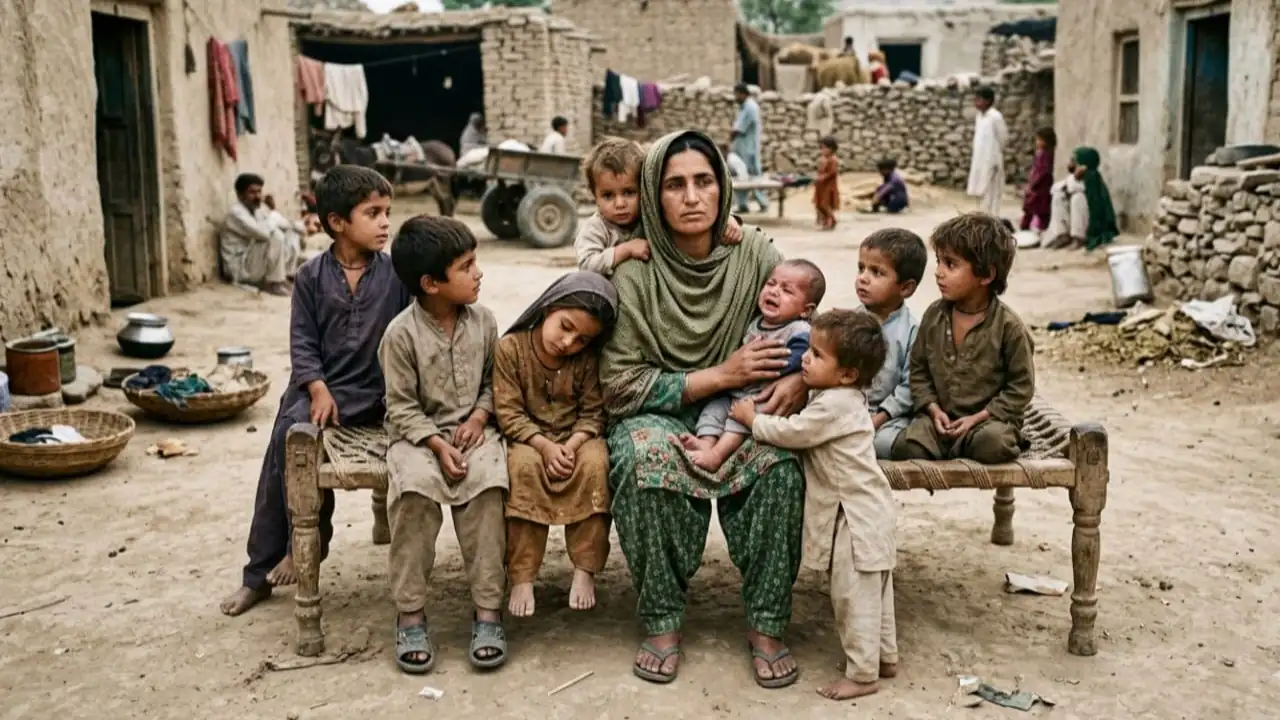
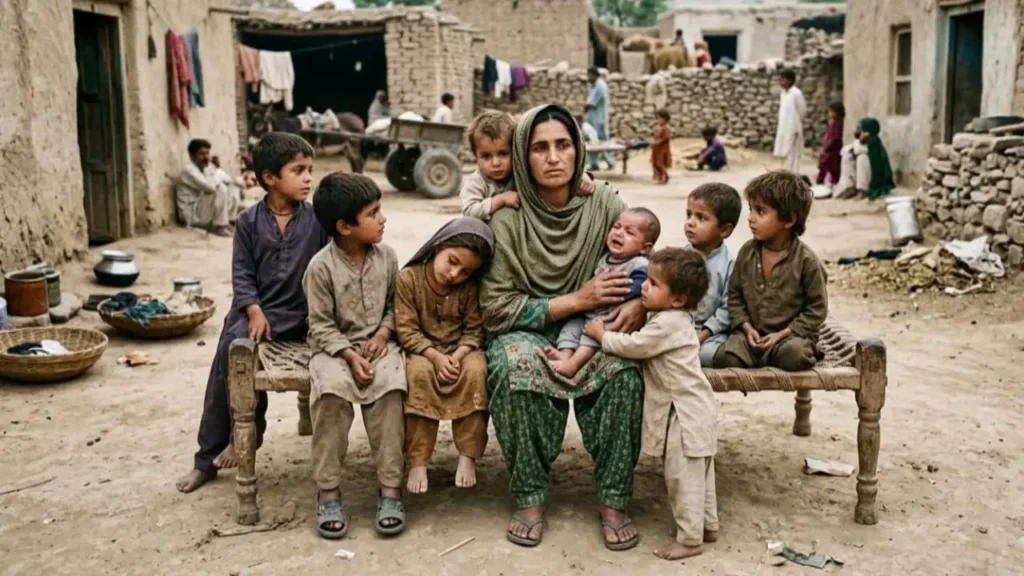

Imagine carrying a heavy weight on your shoulders every single day invisible to those around you, dismissed by your family, ignored by your doctor, and misunderstood by society. For millions of Pakistanis, this is not a metaphor. It is their daily reality.
Mental health in Pakistan remains one of the most neglected public health crises of our time. Tucked beneath layers of stigma, cultural silence, and systemic neglect, it continues to claim lives, shatter families, and undermine the potential of a young and growing nation.
According to the World Health Organization (WHO), approximately 50 million people in Pakistan nearly one in four suffer from some form of mental health disorder. Depression, anxiety, PTSD, schizophrenia, and substance use disorders are widespread. Yet fewer than 10% of those affected ever receive any treatment.
This article is not just a collection of statistics. It is a call to action for policymakers, healthcare professionals, educators, community leaders, and every one of us who believes that the health of the mind matters as much as the health of the body.
“In Pakistan, talking about mental illness is still seen as a weakness. But silence is the greatest weakness of all.”
Before we can address a problem, we must understand its magnitude. In Pakistan, the data paints a sobering picture:
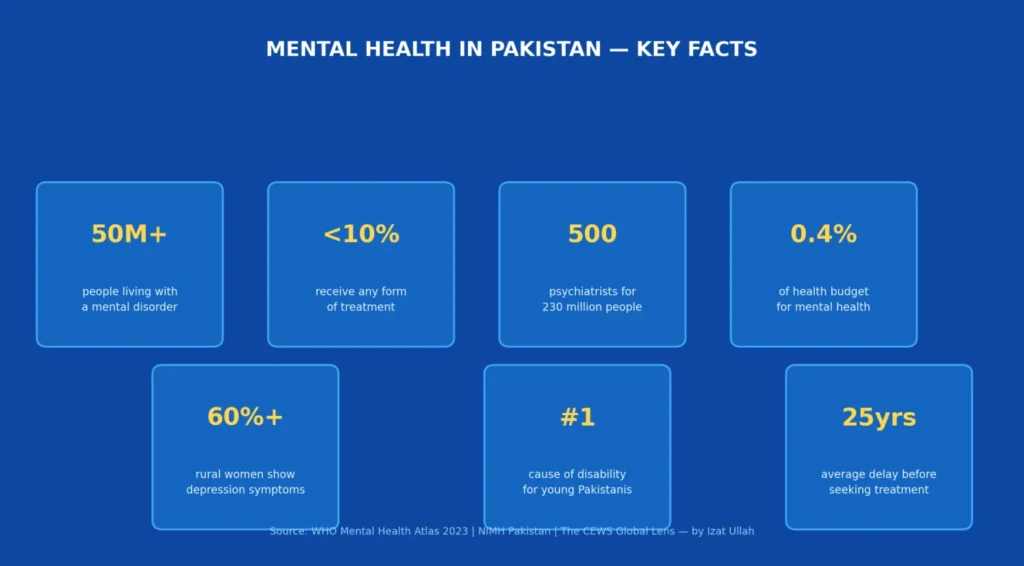
Key Facts: Mental Health in Pakistan at a Glance
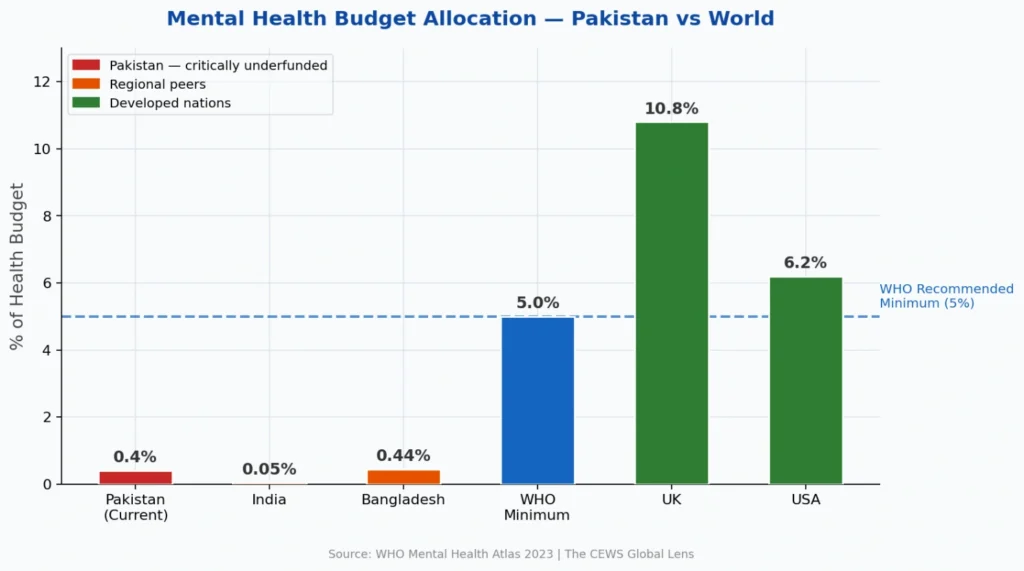
Mental Health Budget Allocation: Pakistan vs Global Benchmarks
As you can see in Chart above, Pakistan’s mental health budget is not just low, it is among the lowest in the world. While countries like the UK spend nearly 11 percent of their health budget on mental health, Pakistan spends less than half a percent. This gap is not an accident. It is a choice. And it is a choice that costs lives.
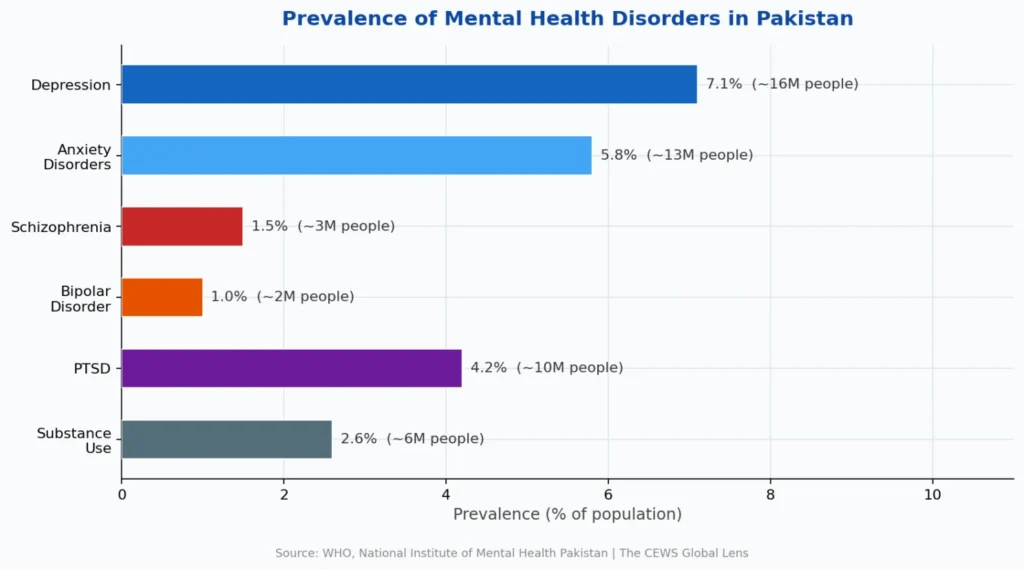
Prevalence of Mental Health Disorders in Pakistan by Type
Understanding the mental health crisis requires us to look beyond the surface. The problem is shaped by culture, history, economics, and governance.
In most Pakistani households, mental illness is not discussed at the dinner table. People who seek help are often labeled ‘pagal’ (crazy), weak, or spiritually deficient. Many families believe mental illness is a punishment from God, the result of black magic, or simply the absence of willpower.
As a result, sufferers are taken to faith healers or chained in shrines. The shame associated with a diagnosis discourages people from speaking up, and forces families to hide their loved ones rather than seek professional help. In a society with limited mental health education and deeply rooted traditional beliefs, stigma’s impact is devastating.
Pakistan has fewer than 500 psychiatrists for a population of 230 million. By comparison, the United Kingdom with a far smaller population has over 10,000 practicing psychiatrists. Pakistan’s mental health infrastructure is concentrated in a handful of major cities, leaving rural communities almost completely without care.
Public psychiatric facilities are overcrowded, underfunded, and in many cases deeply inhumane. Reports of patients being shackled, neglected, and abused in state-run institutions have been documented by human rights organizations.
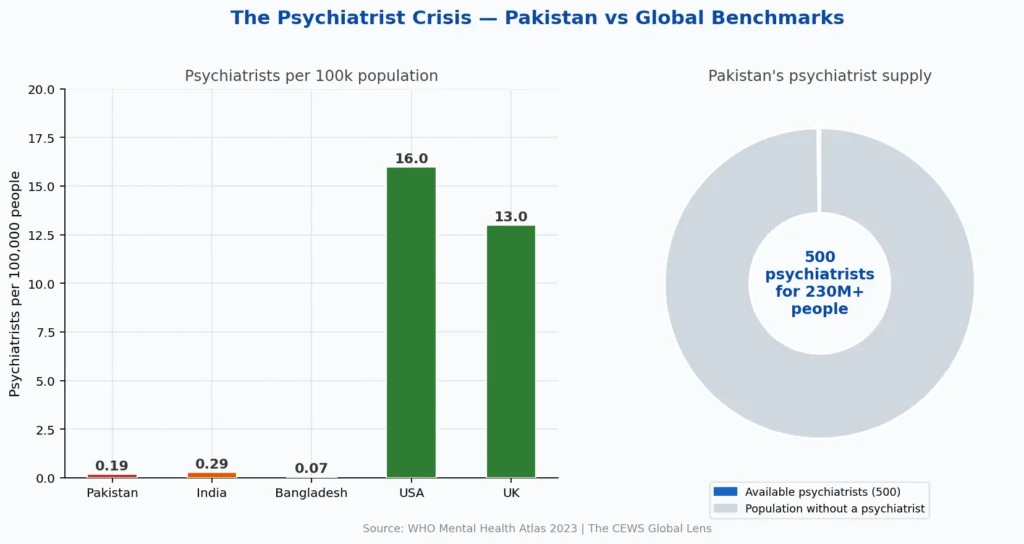
Pakistan’s Psychiatrist Crisis: One Doctor for Every 460,000 People
Pakistan’s economic instability is a direct driver of mental health deterioration. With inflation rates surpassing 30% in recent years, rising unemployment, and widespread food insecurity, millions of Pakistanis live under chronic stress. The financial anxiety of breadwinners, the uncertainty of daily survival, and the hopelessness born from poverty are powerful triggers for depression and anxiety.
Poverty and mental illness create a vicious cycle: economic hardship drives poor mental health, and poor mental health undermines productivity, employment, and economic participation.
Pakistan has experienced decades of conflict in Balochistan, the former FATA regions, Karachi, and along the Afghan border. Millions of internally displaced persons carry the invisible wounds of war: PTSD, survivor’s guilt, grief, and profound social disruption.
Pakistan also hosts one of the world’s largest refugee populations primarily Afghans many of whom fled violence and trauma, with virtually no access to mental health services. The 2010 and 2022 mega-floods have left massive psychological trauma in rural communities, yet disaster mental health remains almost entirely unaddressed in Pakistan’s emergency response frameworks.
Women in Pakistan face a disproportionate mental health burden. Subjected to domestic violence, forced marriages, limited autonomy, economic dependence, and social isolation, Pakistani women particularly in rural areas suffer extraordinarily high rates of depression and anxiety.
Gender-based violence including honor killings, acid attacks, and domestic abuse causes severe psychological harm. Yet women who suffer often have no safe space to report abuse, and seeking mental health support for trauma is culturally almost unthinkable in many communities.
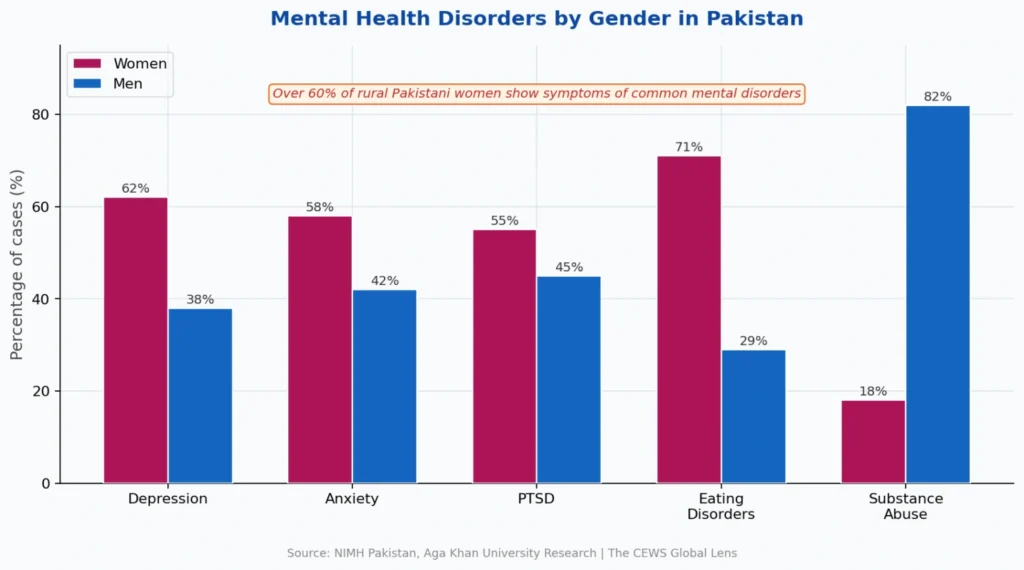
Mental Health Disorders by Gender: Women Carry a Disproportionate Burden
Mental illness does not discriminate. It touches children, youth, adults, and elders in different ways each facing its own barriers to care and its own silent suffering.
Pakistan has one of the world’s youngest populations, with over 64% under the age of 30. Yet child and adolescent mental health services are almost nonexistent. Half of all mental health conditions begin before age 14, and 75% emerge before age 24. In Pakistan, most of these young people will go untreated for years or forever. School counselors are rare, and parents often dismiss children’s emotional struggles as growing pains.
Pakistan’s youth navigate an unprecedented combination of stressors: unemployment, social media comparison culture, the pressure of maintaining traditional values in a rapidly changing world, and anxiety about an uncertain future. Social media has introduced new pressures cyberbullying, body image issues, and validation-seeking cycles. Many young Pakistanis carry undiagnosed anxiety and depression, managing their pain through isolation or substance use.
Pakistan’s older population faces a growing mental health burden amplified by loneliness, loss of purpose, grief, and age-related cognitive decline. As urbanization fragments extended family structures, elderly parents are increasingly isolated. Depression and dementia are rising among seniors but are almost universally misdiagnosed or ignored.
The gap between those who need mental health treatment and those who actually receive it has been widening for decades. As Pakistan’s population grows and stressors multiply economic pressure, climate shocks, conflict, and digital disruption more people are developing mental health conditions, while treatment infrastructure remains critically underdeveloped.
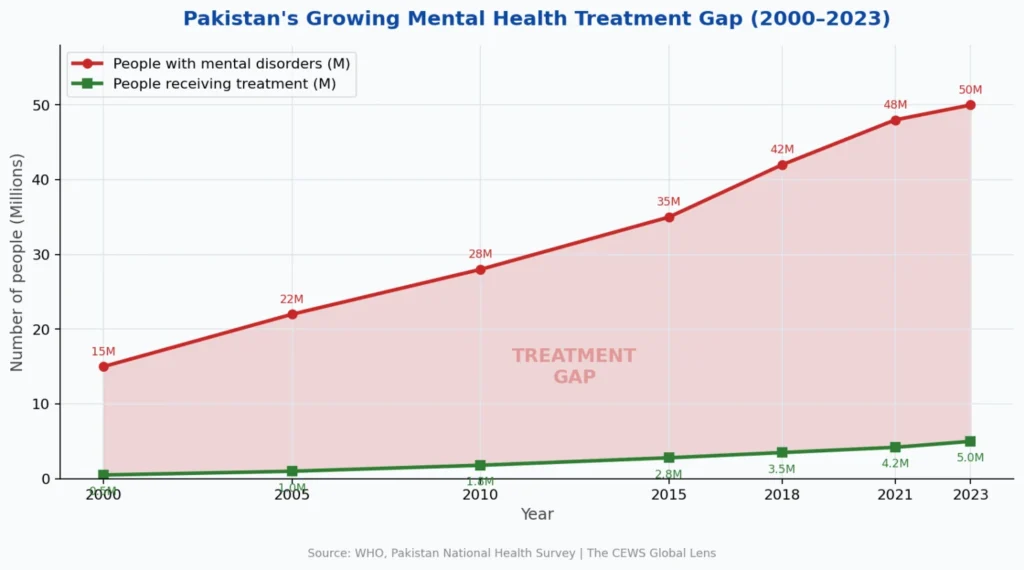
Pakistan’s Growing Treatment Gap: Millions Left Without Help (2000–2023)
The area between the two lines in the chart above represents millions of Pakistanis who are suffering without any professional support. This gap is not just a healthcare failure it is a human rights failure.
“Every unmet mental health need is not a personal failing. It is a failure of the systems that were meant to protect us.”
Suicide is one of the most devastating consequences of untreated mental illness and in Pakistan, it is vastly underreported. Because suicide carries immense social stigma and is legally classified as a criminal act under Section 325 of the Pakistan Penal Code, many families conceal deaths, and they are frequently misclassified as accidents.
Among young people aged 15–29, suicide is believed to be one of the leading causes of death. The criminalization of suicide attempts is deeply counterproductive: rather than encouraging help-seeking, it drives survivors underground reluctant to report their attempt for fear of prosecution. This policy must be urgently revisited.
Against this difficult backdrop, there are signs of progress slow, fragile, but real. Civil society, technology, and a growing youth-led mental health movement are beginning to challenge the status quo.
Pakistan’s 18th Constitutional Amendment devolved health to provinces, meaning mental health policy is now primarily a provincial responsibility. Khyber Pakhtunkhwa passed a mental health act in 2017. Pakistan has committed to the WHO’s Comprehensive Mental Health Action Plan 2013–2030 and has taken early steps toward integrating basic mental health services into primary care through the WHO’s mhGAP programme.
Organizations like the Pakistan Association for Mental Health (PAMH), School of Leadership Foundation, Group Development Pakistan Umang, Rozan, Umeed Welfare Organization and Act International/UNFPA’s National Youth Helpline are filling critical gaps. They provide counseling, crisis support, training for community health workers, and advocacy for policy change. Youth-led organizations are increasingly using social media to destigmatize mental illness and create peer support networks.
The COVID-19 pandemic pushed platforms like Umang Telehealth and Sehat Kahani to expand teletherapy services, making counseling accessible through mobile phones. For Pakistan’s vast rural population where mental health professionals are nonexistent digital platforms may represent the most scalable solution available in the near term.
Acknowledging the problem is the first step. But real change requires bold, sustained, and multi-sectoral action. Here is what Pakistan must prioritize:
Pakistan allocates less than 0.4% of its health budget to mental health one of the lowest ratios in the world. The WHO recommends a minimum of 5%. Closing this gap must be a non-negotiable priority. Mental health infrastructure, training programs, and community care require sustained investment not one-off allocations.
Pakistan cannot wait to produce thousands of new psychiatrists before acting. The WHO’s mhGAP model provides a proven approach: train frontline healthcare workers doctors, nurses, midwives, community health workers to identify and manage common mental health conditions. Pakistan’s Lady Health Workers program, with its vast community reach, represents an untapped opportunity for this kind of training.
Most Pakistanis will only ever see a general practitioner or basic health unit worker. If these frontline providers are trained to screen for depression, anxiety, and psychosis and empowered to refer and treat basic conditions access to care could expand dramatically. Mental health integration into primary care is not expensive; it is a matter of training, protocols, and political will.
Changing cultural attitudes requires sustained, creative, and community-grounded communication. Government, media, religious scholars, teachers, and civil society must collaborate on a national campaign that speaks to diverse audiences in local languages. Pakistan’s religious leaders hold enormous social influence engaging them in mental health education could be transformative.
Pakistan must repeal or revise Section 325 of the Pakistan Penal Code, which criminalizes attempted suicide. Treating a mental health crisis as a criminal offense is medically indefensible it actively prevents help-seeking and causes additional trauma to already vulnerable individuals. A compassionate, evidence-based approach is long overdue.
Pakistan’s youngest citizens and its women carry a disproportionate burden of mental illness. Mental health curricula in schools and universities, safe spaces for young people to seek counseling, and gender-sensitive services for survivors of gender-based violence must be pillars of any serious national strategy.
Policy change matters but so does what happens in our homes, schools, offices, and communities. We all have a role:
Pakistan stands at a crossroads. A young, growing population full of potential is being held back by a mental health crisis that is simultaneously invisible and pervasive. The cost of inaction is not abstract: it is measured in lives lost, families broken, and futures unrealized.
But it is also a crisis that can be addressed. Not easily, not quickly but with determination, compassion, and collective will. The solutions exist. The knowledge exists. What has been missing is the political courage and social commitment to act.
This is not a healthcare problem alone. It is a human rights problem. A development problem. An economic problem. And above all, it is a moral problem a test of whether we are willing to stand with the most vulnerable among us, or look away.
“Mental health is not a luxury for the privileged few. It is a fundamental right of every Pakistani and it is time we treated it that way.”
Let us begin that conversation today. In our homes. In our offices. In our communities. And in the corridors of power where decisions are made. Because every Pakistani deserves not just to survive — but to thrive.
Izat Ullah is a social entrepreneur, humanitarian practitioner, and educationist based in Quetta, Balochistan, Pakistan. He is the Founder and CEO of Chiragh Educational Welfare Society (CEWS) and Co-Founder of Daar-ul-Sanat, a women-led social enterprise. A 2021 Diana Award Winner and 2023 Commonwealth Youth Award Winner, Izat has trained and impacted over 250,000 individuals across Pakistan.