



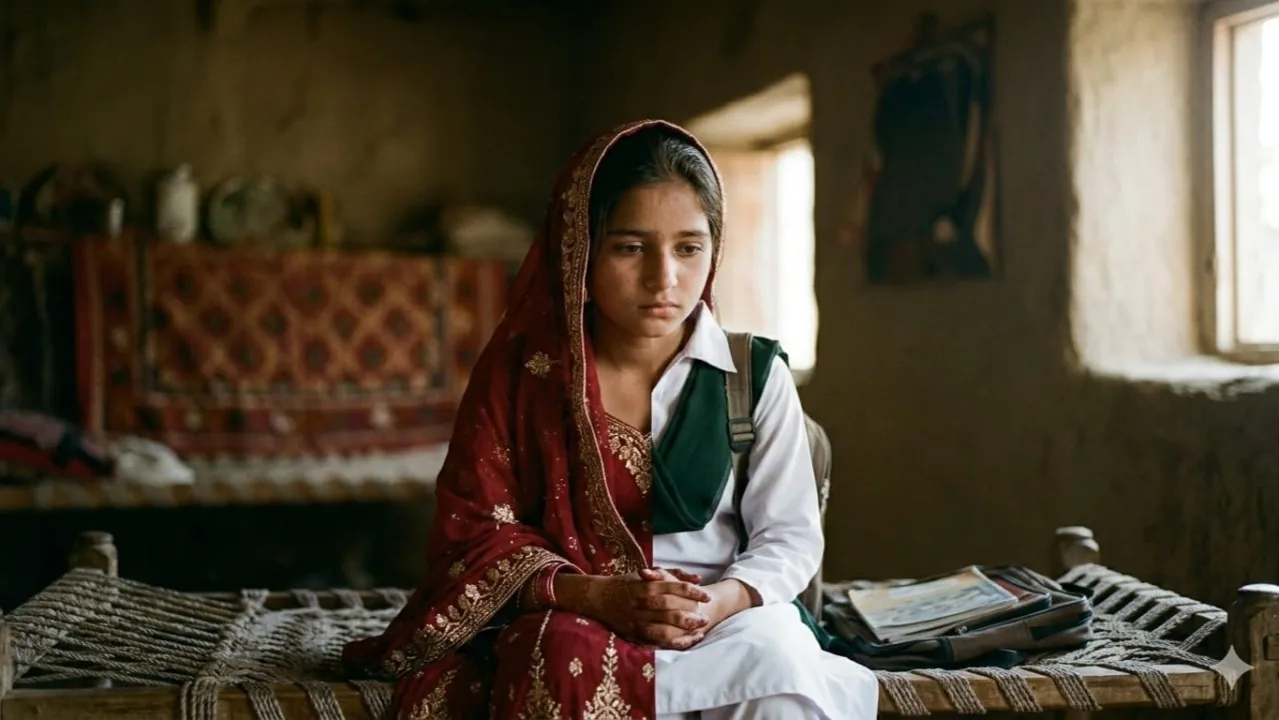
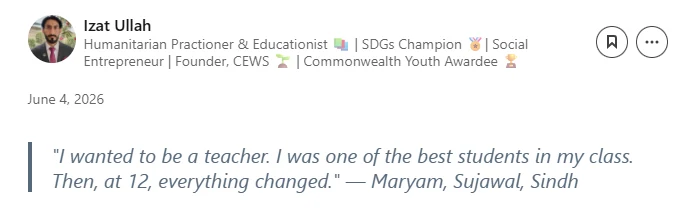
Maryam’s story is not unique. Across Pakistan from the scorching plains of Sindh to the rugged highlands of Balochistan, from the fertile fields of South Punjab to the mountain villages of Khyber Pakhtunkhwa millions of girls like her have had their futures rerouted by a single event: marriage before they were ready, before they were old enough, before they even fully understood what it meant.
Early child marriage is one of the most severe human rights violations affecting Pakistani children today. It is a crisis that hides behind curtains of culture, economics, and tradition but its consequences are written plainly in the bodies, minds, and broken futures of girls across the country.
This special edition of The CEWS Global Lens examines the reality of early child marriage in Pakistan through data, stories, root causes, and consequences because understanding a crisis is the first step toward ending it.
According to UNICEF, approximately 18% of girls in Pakistan are married before the age of 18 representing nearly 1.9 million child brides. That is one in every six girls. Pakistan has the sixth highest number of child brides in the world. But this national average masks stark regional and socioeconomic disparities that tell a far more alarming story.
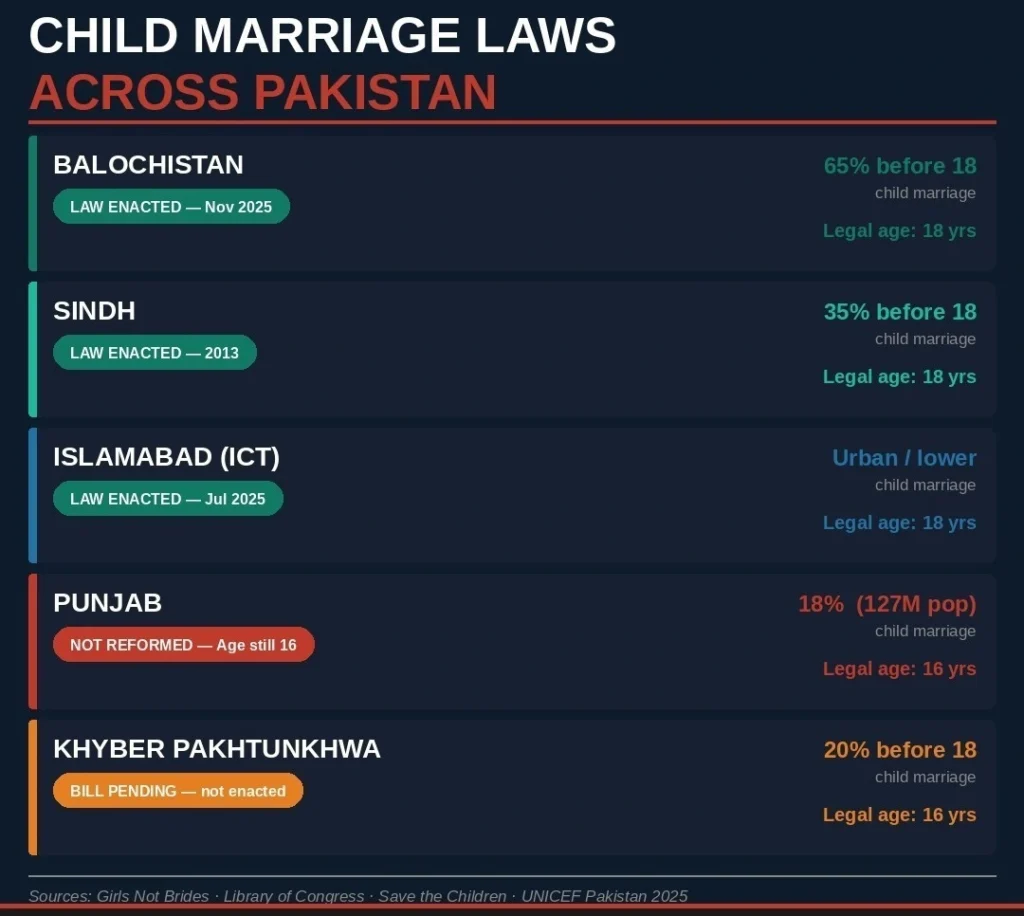
In Balochistan, Pakistan’s largest province by area and among its most impoverished a 2024 survey by Save the Children found that nearly 65% of all marriages occurred before the age of 18, with 40% happening before the age of 16. One in four girls in the province had their first child before turning 16. These are not abstract statistics. These are childhoods.
Poverty is perhaps the strongest predictor of child marriage. Among the poorest households in Pakistan, child marriage affects 34% of girls. Among the wealthiest, that figure falls to just 7%. This is not merely a cultural phenomenon it is a poverty trap dressed in the language of tradition.
Education tells an equally stark story. Girls with no schooling face child marriage at a rate of 34%, compared to just 8% for girls with secondary or higher education. Every year a girl stays in school dramatically reduces her risk of early marriage. Education is not just an opportunity it is a shield.
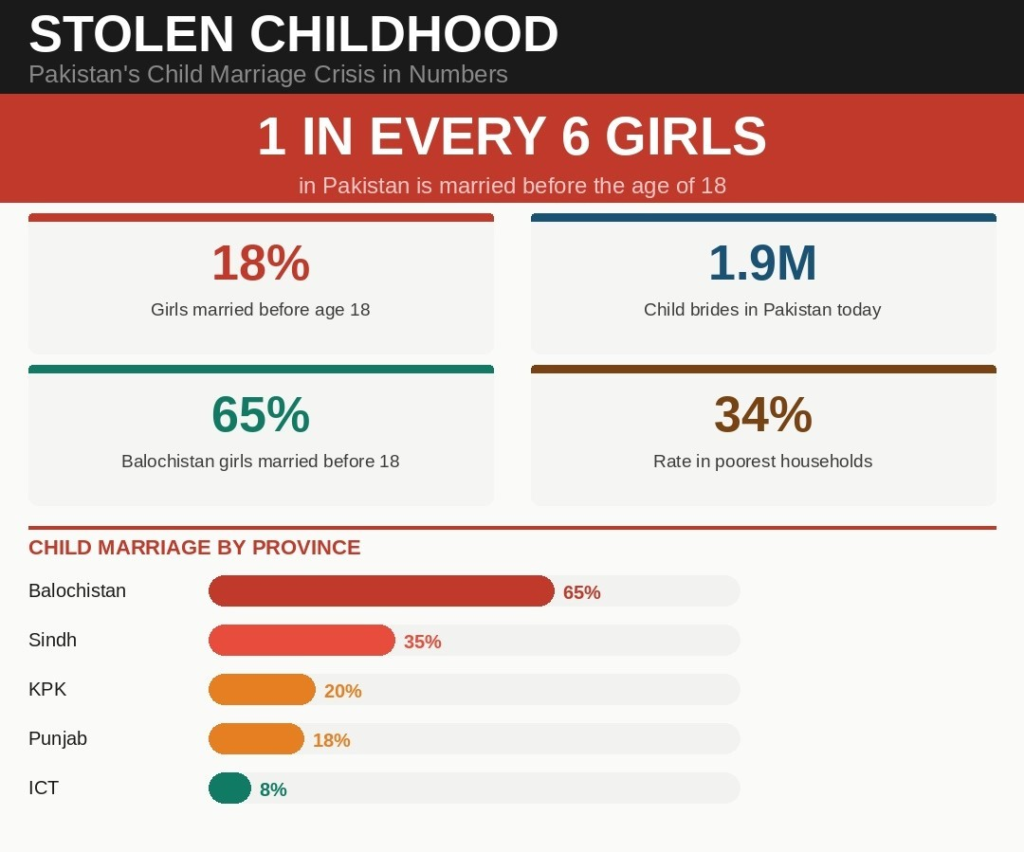
Pakistan’s legal landscape on child marriage is a patchwork the result of the 2010 18th Constitutional Amendment, which devolved child protection to the provinces. Whether a girl is legally protected from child marriage often depends on which side of a provincial border she was born.
Sindh was the first province to act, enacting the Sindh Child Marriage Restraint Act in 2013, raising the minimum age to 18. Balochistan made history in November 2025 by becoming the latest province to enact the same protection a long-overdue milestone for a province with some of the country’s highest rates. Islamabad Capital Territory followed with its own law in July 2025.
Punjab home to over 127 million people, Pakistan’s most populous province still legally permits girls to marry at 16. Khyber Pakhtunkhwa’s cabinet has approved a draft bill, but it has not yet been enacted. The colonial-era federal Child Marriage Restraint Act of 1929, which sets the age at 16 for girls, remains in force wherever provincial law has not replaced it.
Child marriage does not exist in a vacuum. It is the product of overlapping systems of poverty, patriarchy, limited opportunity, and weak governance. To end it, we must honestly understand it.
In many Pakistani households particularly in rural Sindh, southern Punjab, and Balochistan daughters are seen through an economic lens. Marrying off a daughter reduces household expenditure: “one less mouth to feed,” as one Balochistan community member told Save the Children. Bride price and dowry systems create perverse financial incentives that turn girls into transactions rather than people.
Child marriage rates spike sharply following economic shocks and natural disasters. Pakistan among the world’s most climate-vulnerable countries has experienced unprecedented flooding in recent years. In the aftermath of the 2022 mega-floods, reports of girls being married off to cut family costs surged in affected districts across Sindh and Balochistan.
Deeply ingrained patriarchal norms equate a girl’s honour with her early marriage. Many families genuinely believe that marrying daughters young protects them from harassment and social stigma. Harmful practices such as Watta Satta exchange marriage Vani, in which girls are given away to settle tribal disputes, and Swara, where girls are used to resolve blood feuds between families, remain practiced in parts of Pakistan. These customs treat girls as property rather than as human beings with rights.
Pakistan’s out-of-school children crisis and its child marriage crisis are deeply intertwined. An estimated 5.9 million girls of primary school age are not enrolled in school. When girls are not in school, they are perceived as “available” for marriage. Weak schools, poor infrastructure, safety concerns, and cultural barriers keep girls at home. And home, for many, becomes a short path to marriage.
Even where laws exist, they are rarely enforced. Pakistan lacks a comprehensive digital birth registration system, making it easy to misrepresent girls’ ages at the time of marriage. Nikah registrars the officials who officiate marriages face minimal oversight. In 2024, the Lahore High Court ruled that registrars who breach guidelines to curb child marriage will face legal action. It is a significant step, but translating court orders into community-level behaviour remains the central challenge.
At the most fundamental level, child marriage is a symptom of a society that does not equally value girls. Pakistan ranks 137 out of 139 countries on the 2024 SDG Gender Index second from the bottom globally. When girls are not valued as individuals, their childhood, education, and future become negotiable.
If the causes of child marriage are complex, the consequences are devastatingly simple. Early marriage ends girlhood and begins a cascade of harm that extends not just through one lifetime but across generations.
Girls married young face immediate and severe health consequences. Their bodies are simply not developed enough for pregnancy and childbirth. The risks of obstetric fistula a debilitating childbirth injury that leaves girls incontinent and often ostracised along with eclampsia, haemorrhage, and maternal death, are dramatically elevated for teenage girls. In Balochistan, 60% of surveyed girls gave birth before 18. One in four gave birth before 16.
Research published in 2025 confirmed that children born to mothers who married young score lower across all childhood development indicators physical, cognitive, emotional, and social. Child marriage thus creates an intergenerational cycle of disadvantage that no single intervention can easily break.
Girls aged 15 to 19 in Pakistan face the highest rates of domestic violence of any age group 24.3% experienced violence in the past 12 months. According to UNICEF, 55% of married women in Pakistan believe that wife-beating is permissible. UNFPA reports that one in three child brides in South Asia faces domestic or sexual abuse. Young brides are isolated from their families, stripped of legal recourse, and entirely dependent on their husband’s household. They have nowhere to go, and often no one to tell.
Marriage almost universally ends a girl’s schooling. The transition from student to wife managing a household, serving in-laws, bearing children leaves no room for the classroom. Girls who drop out rarely return. This permanent educational truncation means girls never develop the qualifications and confidence to participate meaningfully in economic life. A child bride almost always becomes a financially dependent adult woman vulnerable, voiceless, and trapped.
The consequences of child marriage extend far beyond individual girls. A World Bank study estimated that child marriage costs developing countries trillions of dollars by 2030, through lost productivity, increased healthcare costs, and intergenerational poverty. UN Women and Pakistan’s National Commission on the Status of Women have documented child marriage’s measurable drag on economic growth. A nation where millions of girls are denied education and economic participation never reaches its full potential.
2025 was a significant year for legal reform on child marriage in Pakistan. The Islamabad Capital Territory enacted the Child Marriage Restraint Act 2025, raising the minimum age to 18 for both boys and girls. Balochistan followed in November 2025 a historic milestone for a province where the crisis has long been most severe. These achievements came after years of sustained advocacy by civil society organisations, journalists, religious scholars, and community leaders.
Religious opposition has historically been the primary political obstacle to reform. This position was formally rejected by Pakistan’s Federal Shariat Court in 2022, which ruled that existing child marriage restraint laws are entirely consistent with the injunctions of Islam. That landmark ruling removed the legal basis for religious objections but political and community resistance persists in practice.
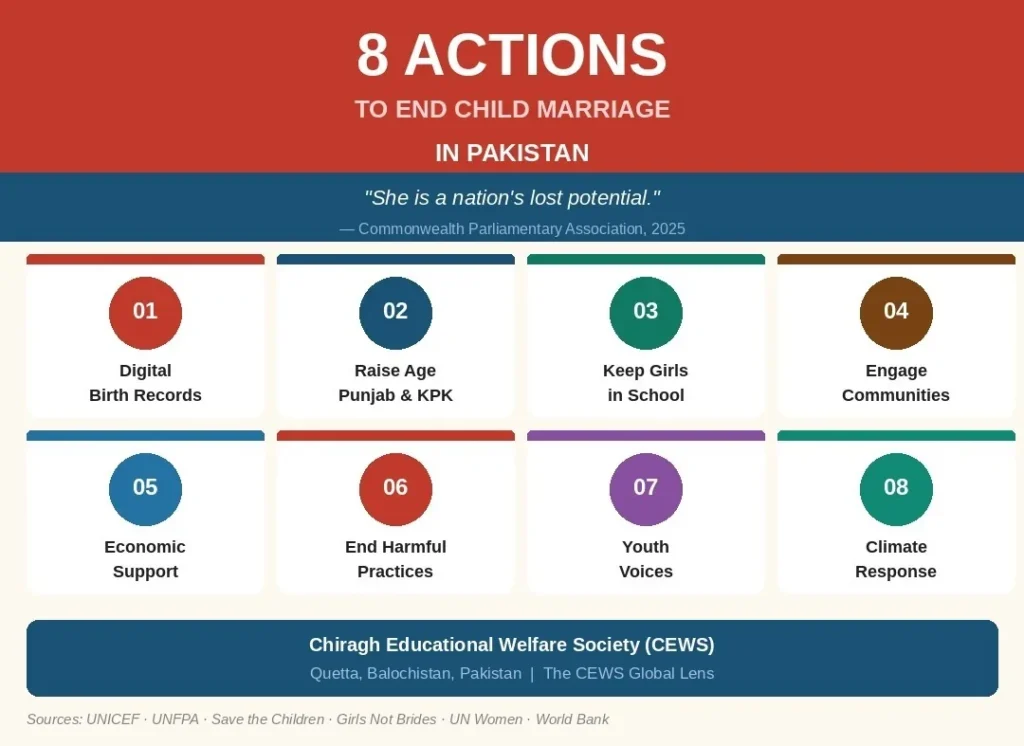
Serious gaps remain. Punjab home to over 127 million Pakistanis still permits girls to marry at 16. Khyber Pakhtunkhwa has a bill waiting in the legislature. The federal 1929 law remains the default in unprotected jurisdictions. And across the country, law without enforcement is simply paper. Pakistan urgently needs universal digital birth registration, strict oversight of nikah registrars, and sustained community-level implementation to ensure that new laws translate into real protection for real girls.
Ending child marriage in Pakistan requires a multi-layered, sustained, and culturally intelligent response. There is no single solution but there are clear, evidence-backed steps that work.
At Chiragh Educational Welfare Society, we believe that the future of Pakistan is built in its classrooms not in premature marriages. We have seen, in the communities we serve across Balochistan and beyond, what happens when girls are given the chance to stay in school, to dream, to lead. We have also seen what happens when they are not.
Through our scholarship program, CEWS has protected hundreds of girls by providing scholarships that enable them to pursue their education with dignity and without financial burden keeping them in school and giving them the freedom to shape their own futures.
Child marriage is not an inevitability. It is a choice made by families, communities, governments, and societies. And it is a choice that can be unmade. The data is clear. The consequences are documented. The path forward is known.
What is needed now is political will, community courage, and the collective commitment to protect every girl’s right to a childhood, an education, and a future of her own choosing.
Because a child who marries before she is ready is not just a girl whose life is changed. She is a story that was never finished. A dream that was never allowed to become real.
It is time to let the girls finish their stories.
“A child bride is not just one less girl in school; she is a nation’s lost potential.” — Commonwealth Parliamentary Association, 2025
UNICEF Pakistan — Child Marriage Country Profile (2018–2025)
Save the Children — Balochistan Child Marriage Survey (2024)
UNFPA Pakistan — Child Marriage Programme Data
Girls Not Brides — Pakistan Country Profile (2025)
UN Women / NCSW — Child Marriage in Pakistan: Punjab and KPK (2020)
Child Marriage Data Portal — childmarriagedata.org
Commonwealth Parliamentary Association — Child Marriage Bill Analysis (2025)
SpringerLink — Child Marriage and Maternal / Child Health in Pakistan (2025)
SDG Gender Index 2024 — Pakistan ranking (137 out of 139 countries)
Library of Congress — Pakistan Islamabad Child Marriage Law (2025)